
|
This is my blog about China, written from the point of view of the average bloke on the street. Or at least its my point of view of his point of view translated into English, if you get what I mean… |

|
Monday February 15th, 2010 |
|
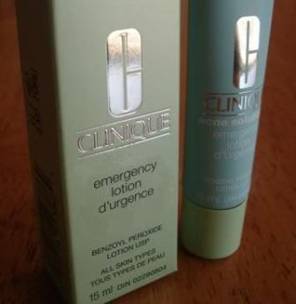
Emergency Face Pack |
|
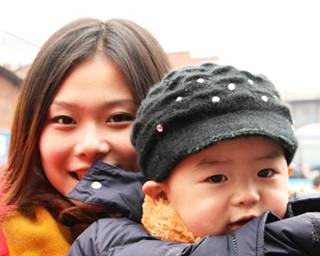
New mum had given up her job to have the baby. New dad was still working at the same company. Their classmate had been in Chengdu for a while now and was hoping for a new job. Rui’s turn. She went with 400 other applicants to the Qatar Airways recruitment fair in Chengdu, and was one of 7 candidates chosen to be sent abroad, earn 20 times her father’s salary and be sent to every major economy in the world on 5-star expenses. That wasn’t how Rui put it, but by the looks on their faces that was what they got. I felt our position was strong, and started to relax. This was the first in a series of errors. |
|
Rui’s High School friend recently had a baby. We took presents, of course. I suggested something for mum, since if the UK is anything to go by then everyone ignores the poor woman who has been through Hell and showers useless items on a baby that refuses to move. So Rui came back from the shops with some expensive Emergency Face Pack, and a selection of baby clothes. We bumped into another High School classmate also on the way to visit. The new mum was pleased. He and Rui were the first schoolmates to visit, and after a few minutes of coochey-coo, it turned into a miniature school reunion. |
|
Congratulations were enthusiastically expressed. Then a query. “What’s he going to do?” The warning lights were now all flashing red, but unfortunately someone must have switched the alarm to silent mode. Rui hesitated, then looked at me, and with a sigh said “I don’t know really. Tell them what you think about it, darling.” |
|
This was a massive tactical blunder. Rocking my shoulders a bit, I made a little chuckle sound. “I’m just going to carry on studying and Rui’s going to have to look after me, heh heh.” For a moment there was a silence, as though a bomb had gone off, the room only surviving in my imagination. Rui cut through to my consciousness. “Darling.” Her teeth were gritted together so hard I thought I could see splits appearing up the enamel. “I have absolutely no face left whatsoever,” she said in English, “do something to save my face immediately.” I took stock of the situation. I could now see that we were hurtling towards the ground having lost control, and the best I could do would be try to pull up and hope for 50% fatalities. I grappled with the controls. “I dunno, I guess, it’s just a little joke about cultural differences my love.” A full investigation will take years to complete. However, an interim report by the investigating authorities suggested urgent research into new “Emergency Face Packs” in order to avoid similar catastrophic accidents in the future. |
|
Saturday September 23rd, 2010 |
|
Lost in transl… nope, actually just completely lost. |
|
Most foreigners who spend more than a week in China soon get over being amused my bad translations into English, and photographing them would merely take up all of one’s spare time. However, a recent encounter this week encouraged me to put together an inch or two of a few favourites I’ve seen. |
|
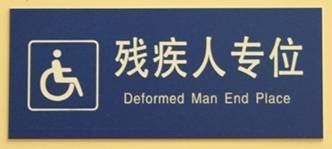
This translation for ’Disabled Toilet’ is one of my favourites. The interesting thing is that the Chinese does indeed say ’disabled toilet’, and like ’Disabled Toilet’ doesn’t distinguish male or female. For the rest of my life I shall occasionally wonder what on earth they could have written on the one in the female toilet. Chengdu Shuangliu Airport, May 2010. |
|
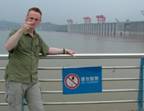
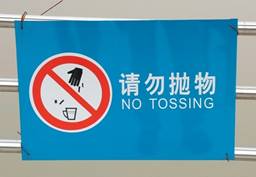
Perhaps only 14 year-old schoolboys would find this funny, anyway, I did as well. |
|
To be fair, our cousins in the USA probably wouldn’t have noticed anything that bad about this translation. Three Gorges Dam, September 2007. |
|
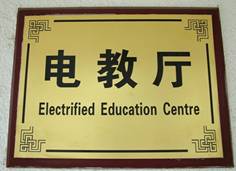
Clearly, it’s not the 99% probability that the translation isn’t quite perfect, but the 1% possibility that they actually got the translation completely correct. On that basis, this sign wouldn’t seem the slightest bit interesting in a laid back coastal resort on the med. Jingzhou City, Hubei Province, September 2007. |
|
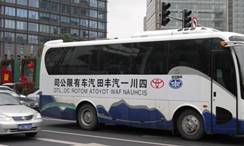
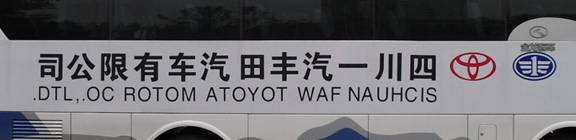
The rubbish written on the side of this bus wouldn’t at first appear to warrant more than a few seconds of scornful consideration. Then I read the Chinese. |
|
It needs some explaining. Chinese characters are much more flexible than letters of the alphabet. Books are often written left to right in paragraphs, as in English, but it’s also entirely normal to print a book with vertical columns for each sentence instead, and also starting at the back, reading the book from right to left. Buses are much more interesting. On the left-hand side of a bus they will write the characters as you would expect to see them in a book or in a newspaper. But it seems to be important to have the first character at the front of the bus, so that the sentence is ‘going forward’ when the bus moves, as it were. This means that on the right-hand side of the bus, the beginning of the title is on the right, and the end is on the left. Armed with this information, have another look at the title of the bus in English. Chengdu, September 2010. |
|
Saturday October 2nd, 2010 |
|
Neighbourly Love |
|
The Media back at home have been pouring over some grainy pictures of Kim Jong-Un when he was a kid, and falling over themselves to find any other tiny details they can from mysterious and secretive North Korea to include in their news reports. The relationship here, however, would appear to be a far more ‘touchy feely’ than it is back at home. |
|
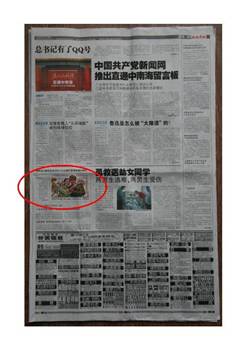
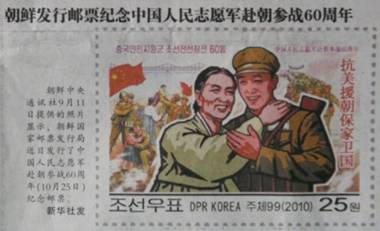
Back on the 12th September, before all this coverage, the Chengdu Business Daily had a lovely article, tucked away on page 7, reporting that North Korea were currently publishing stamps to commemorate the 60th Anniversary of the Chinese People’s Volunteer Army coming to the aid of the embattled state during the Korean War. |
|
Particularly touching are the background scenes of soldiers hugging babies and children and generally showing their love all round to the Korean people. (Voluntarily, by the way.) |
|
The writing in (Mainland style) Chinese characters on the right-hand side sums up the feeling nicely: “Resisting the Americans, Helping the Koreans, Saving Home and Country”. How touching, and, if I may say, what a lovely display of mutually respectful and carefully thought out diplomacy. The short article doesn’t say what the Chinese Government thinks about the stamps, but then, it doesn’t really need to; the press release is credited to the Xinhua News Agency itself - the Chinese Government’s own news organisation. |
|
Thursday February 24th, 2011 |
|
My Beautiful Essay |
|
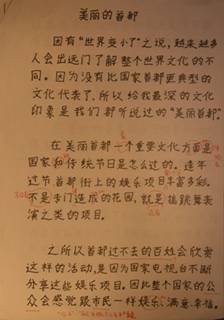
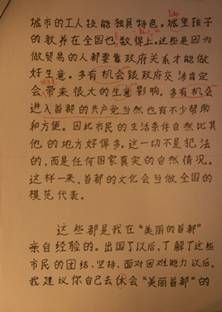
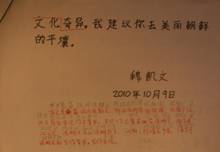
Last semester we were asked to write a rather boring ‘Introductory / Descriptive Essay’, entitled ‘Beautiful xxx ‘, about whatever we wanted. I decided to follow the outline, but add some British irony. You can decide whether it worked or not. My teacher clearly didn’t… |
|
The Beautiful Capital Because the world is getting smaller, more and more people are going away to discover differences between places across the world. Because there is no better model of a country than the capital, my deepest impression is of the capital city of which we have all heard. |
|
This is a ‘discussion essay’, the discussion content is relatively deep and extensive, but this is not in compliance with the rules of a ‘descriptive essay’. This time the instructions were to write a ‘descriptive essay’, and were not to write a ‘discussion essay’. In a ‘descriptive essay’ descriptions are the most important, discussion and emotion should be rare. Please go and study the rules of a ‘descriptive essay’ and how it should be written. |
|
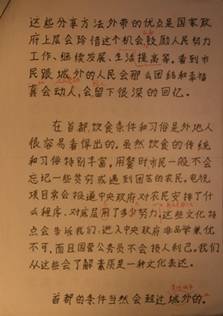
In the Beautiful Capital an important culture is how people pass national festivals. At this time the streets are packed, and recreational activities are abundant. If its not specially constructed floral displays, then it’s dancing shows [which can be seen]. |
|
So that ordinary people who can’t get to the capital can enjoy the activities, television channels continuously cover these activities. Because of this, the audience across the country can feel as satisfied and harmonious as that in the capital. Due to this, the Government can also take this opportunity to encourage the ordinary people to work hard, continue the development, and improve living standards. To see city dwellers and those from outside existing so unitedly and harmoniously is very moving, and leaves a deep memory. |
|
In the capital the customs and good level of food is easy for outsiders to see. Although traditional food and customs are very bountiful, when having a meal people in the city do not forget the poor and struggling peasants. State television often reports how government organised programs help the lowest level people. These cultural points can tell us: to enter the Central Government of course requires both morality as well as scholarly skill, and civil servants could not ’further themselves at the expense of others’. From this we can know that one’s general level of education is an expression of culture. |
|
The standards in the capital of course exceed those outside. The abilities of the workers are many and various. The upbringing of the children is among the best. This is because business people all have to have dealings with the government in order to do business. To have more opportunities to negotiate with the government of course affects business greatly. More opportunities to enter the Communist Party of course brings many benefits and convenience. For this reason people living in the capital have better standards than those of other places. These things are not illegal, but naturally the actual situation in any country. In this way the culture of the capital can represent the modal culture of the whole country. |
|
This is all what I have experienced in The Beautiful Capital. After going abroad, knowing this unity, persistence, and ability to face difficulties I would recommend you to experience the amazing culture of The Beautiful Capital, would recommend you to go to this beautiful Pyongyang in North Korea. |
|
Monday November 29th, 2011 |
|
Off-the-shelf vs Off-your-trolley |
|
The recent holiday period has seen lots of articles about how you could spend your time, or your money, during the many days off which you get in the Autumn here. |
|
Surely there must be cheaper clothes available for this poor woman? The article has the answer: “For more ordinary ones we recommend ‘New Yorker’ at Isetan Department Store, where men’s tailored suits are normally around 5000 RMB” (£504 GBP / $785 USD). She later says buying an off-the-shelf size isn’t recommended, as suits are “not traditional Chinese clothing” and are often unsuitable. After seeing that price, I’m not sure I’d really care, but clearly I don’t know anything about fashion. |
|
Is this possible? Sadly, I reckon it is. Firstly, Chinese people don’t make mistakes with the prices of things, so it’s not likely to be a typing error. Secondly, this sounds just like a typical snapshot of the luxury goods market in China. It’s not just about buying something expensive, it’s about showing people that you can buy something expensive. Something good quality, but very reasonably priced, therefore, isn’t going to sell as well as tat which everybody knows costs three times the price. If a Chinese businessman takes you out on an important dinner and you end up drinking red-wine, he will order the most expensive bottle on the wine list. Does he want to make sure you enjoy the best wine? Not really; he will buy the most expensive wine, regardless of whether it’s the best one or not. He does, however, care that you notice the price. |
|
I read a regular column called ‘You Ask, I Answer’, and had a helpful answer to one woman’s question about clothes. “Where can you order (Western Style) suits in Chengdu? My husband’s a bit fat, where can I buy clothes for chubby people?” The paper’s fashion reporter helps with the answer, “High quality custom-made clothes in Chengdu are already becoming more and more common”. She lists some shops, and the prices, ”prices normally start from about 100,000 RMB for an outfit”. (That’s about £10,080 British Pounds, or $15,700 US Dollars.) Ouch. |
|
Sadly, publishing from behind the Great Firewall of China is a complete pain up the backside (my internet gets cut not long after opening an FTP file), so my updates are only likely to come at Christmas and maybe if I come home in the summer… so don’t hold your breath, as they say… |

|
Sunday September 16th, 2012 |
|
The view from above the street |
|
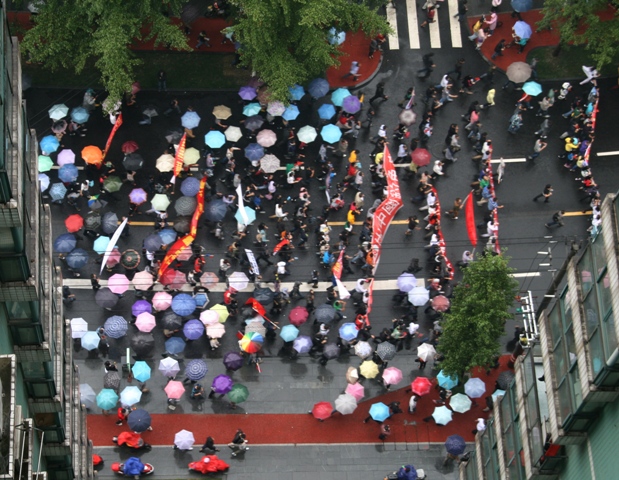
I never thought there was much point writing about Chinese politics, since the most useful information comes from the Economist and sometimes the BBC, so it’s not very novel to repeat all of that. But when the ‘defeat Japan, up the PLA, defend the Diaoyu Islands’ group passed by my window today, I thought it was worth the odd pixel. I should point out that following this lot were only about another 20 or 30 people, and the front row is the one on the right. Well, it was lashing it with rain. In a city of 20 million people you can decide for yourself whether it was a big demo or not. I had to wrangle with my love of taking photographs before deciding that joining a protest against foreigners would be risky, if not moderately insane, even with a big nose. |
|
There is some vaguely interesting background info though… During the last demo two or three weeks ago my girlfriend accidentally arranged to meet a friend in the main square (I’ve asked her several times and she swears it was a complete accident). The interesting points are 1. she phoned me from the square during the protest, so, no problem with the signal 2. she told me in English and then twice in Chinese that there was a huge demo there, and her phone has been working fine since 3. she even sent me a text later to say it was still going on and that she was leaving. You can decide for yourself, therefore, whether the event was sanctioned by the authorities or not. |
|
On the slightly more gossip / funny level, my neighbour, who went to the last protest, said to me in the lift two days ago that it was a good job I wasn’t Japanese otherwise he would have been banging on my door to offer me out for a fight. This wasn’t that funny, but the other guy (also about 5ft tall) in the lift said to him ‘If you tried to beat him up I don’t think you would get very far anyway mate’, which I thought was funny. For insurance purposes, by the way, I said I hated Japanese and would be joining in all future protests. And the twat actually believed me. I make that 2:0. |
|
Thursday September 27th, 2012 |
|
Nice work if you can get it |
|
The usual Western view of Chinese media is that it is one-sided and doesn’t give a complete picture of the world. According to this theory we should all be reading Western news websites if we want to know what’s going on. I’m going to prove that this is completely untrue. |
|
Take my local, the ‘Chengdu Business Daily’. When it comes to the inside story of what is happening in North Korea, clearly this paper has contacts at the highest level. I’m not joking. When Western media outlets were poring over grainy screenshots of Kim Jong-un and his wife with what appeared to be a giant unlicensed Mickey Mouse, this paper ran a full page story with crystal clear shots of him and his wife, including pre-marriage shots of her career as a singer, and even gave the age of their daughter. If London’s Fleet Street wouldn’t call that a scoop, I don’t know what is. |
|
This time they’ve done it again. Earlier in the week a ‘reliable story’ seemed to go round Western media that North Korea was going to ‘implement some modest reform of farming’, with a reduction of how much produce would have to be given to the state. |
|
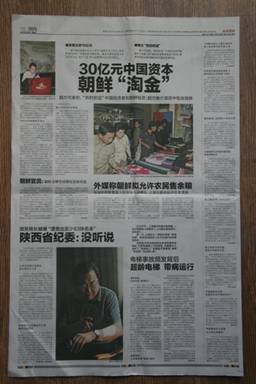
It turns out that the silly big-noses in London and elsewhere don’t even know the half of it. Last night’s paper ran an article inviting investment in North Korea from Chinese investors and investment groups starting at an initial investment of 1 billion Chinese RMB (today that’s 98m British Pounds, 159m USD), rising to an eventual total of 3 billion RMB (294m GBP, 476m USD). The article states that the bulk of the investment will be directed towards the mining industry, specifically rare earth metals, crude oil, magnesium and iron ore mining, but also names other areas seeking investment including basic infrastructure (urban infrastructure projects, a new 376km high-speed railway from Siniuju through Pyongyang to Kaesong with public highway, a sea-port development and an airport in the Roson Special Economic Zone), real estate development including three 5 star hotels in Pyongyang and two other cities, and last but not least, investment in agriculture and service industries. Wow. It even details the legal changes which have been made to protect investors, including the names of the bills and the legislative body which has approved them, and details the ‘BOT’ (Build, Operate, Transfer) framework for the public-private partnership planned for building the railway. |
|
Now, forgive me if I’m wrong, but I don’t recall seeing any of that on the BBC. Mind you, given that Chinese investors are not known for their in-your-face questions about human-rights and public accountability I’m not sure that there will be any big invitations to Western investors any time soon, even if they did have any money. Nice work, as they say, if you can get it. |
|
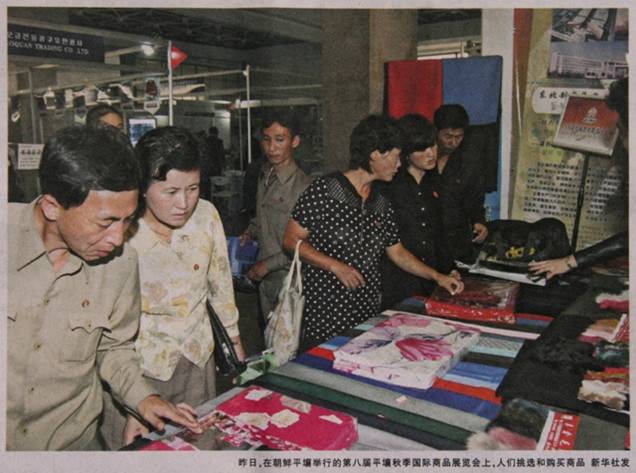
The photograph they chose nicely sums up Chinese people’s image of North Korea - just look at the attention the woman is paying to the massive selection of incredible quality cloth, which it looks like she has never seen before in her life. Her husband looks like he understands though - don’t touch what you can’t afford… |
|
Wednesday January 2nd, 2013 |
|
Ring in the changes |
|
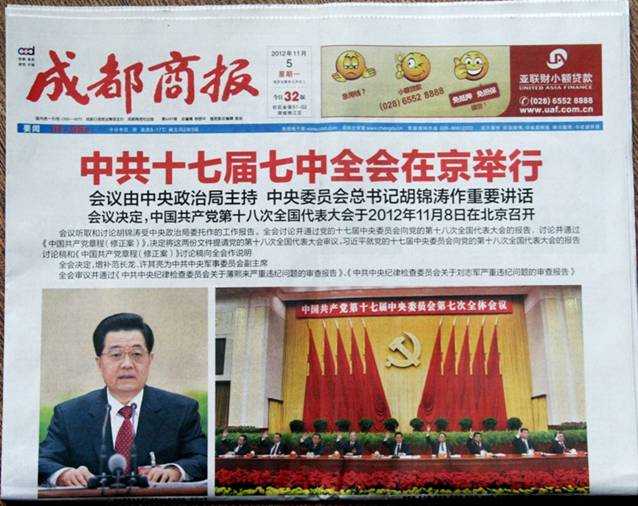
So many changes; a new year, a new Mayan Calendar so we can live another 2500 years, and yes, even a new Chinese leader. Of course, unlike the rollercoaster of knowing whether we were going to live to see a new Mayan era or not, the Party in China is very business-like, meritocratic and results driven, and the appointment of a new leader is merely like the appointment of a new CEO of a major company. How could you possibly expect all the uneducated workers on the factory floor to choose an effective new CEO? No wonder the West is in crisis. |
|
China Blog |




|
Kevin Munns |

|
The view from the street… |

|
China Blog |







|
The recent changes did just remind me of a little story, however. |
|
A Chinese person I know went for an interview to be a cabin crew at Sichuan Airlines. He got an offer, but there were strings attached. Pretty heavy ones, as it happened. They first told him that they could offer him a job, but because the positions were in high demand he would have to pay (in British pounds) 18,000 GBP to the company before he could be accepted. Then he had a health check, the result of which was that he had a small problem with his heart. (Let’s face it, I would have too.) This could still be acceptable, but now he would have to pay 25,000 GBP to the airline before he could be offered the position. |
|
The key point, obviously, is how much the salary is. I have another friend who has been cabin crew for Sichuan Airlines for 2 years, and he gets about 600 GBP per month on average. Twenty-five thousand pounds, therefore, will probably take a long time to pay back. I met the first guy, buy the way, when he was studying English so that he could apply for jobs in foreign airlines based abroad. |
|
Naturally, this topic “came up in conversation” in my English classes. The class was mainly divided on whether they believed the story or not. Luckily at the first class there was a student who worked in HR in a bank, and she immediately told a story of how one girl had to pay an even bigger sum to work as a cashier with an even lower salary. The aghast students asked why she had paid (because she now works in the bank), and the HR person said “because her family think that this is a good job”. |
|
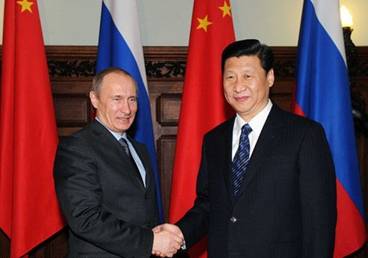
Luckily though, the appointment to the Party of officials to high office couldn’t possibly be based on anything other than merit, and I know because it says so in the paper. That’s lucky, then. |
|
Very professional. |


|
China Blog |